The Day the Fog Spoke: A Childhood Moment, Part 2
-Michael Joly
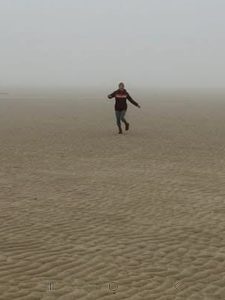
When I look back now, I think of that foggy morning as my first Garden.
It was a state before I knew how complicated and unsafe the world could be, before I started to form defenses and identities. Before I learned to divide things into this and that, safe and unsafe, me and not‑me. I had not yet learned to armor up, react from fear and regret it later.
I was simply a child sitting on a rock, listening to tones in the fog, feeling both anchored and expanded.
That moment never left me.
Decades later, when I started recording metallophone tones, then building the n.o.w. Tone Therapy System, and eventually evolving that work into ToneStream, I realized I was, in some sense, trying to recreate the conditions of that day: simple sounds unfolding in space, inviting a listener back into safety and curiosity at the same time.
I didn’t know the word “consciousness” at five. I didn’t know the word “mindfulness.” I didn’t know what a spiritual teacher was. But for those few minutes, listening to overlapping foghorn tones come and go in greyish air, I was fully present. No commentary. No plan. No practice. Just sound and awareness.
Later, as an adult, I began to recognize that quality of attention when it appeared in other forms: the way the bells of the Frankfurt Cathedral could still time, the way a harmonically-tuned interval could soften my breath, the way simple sounds and slow pacing could open a sense of “there’s more out there than can be seen”—without requiring belief.
Little by little, I began to see a line running through my work.
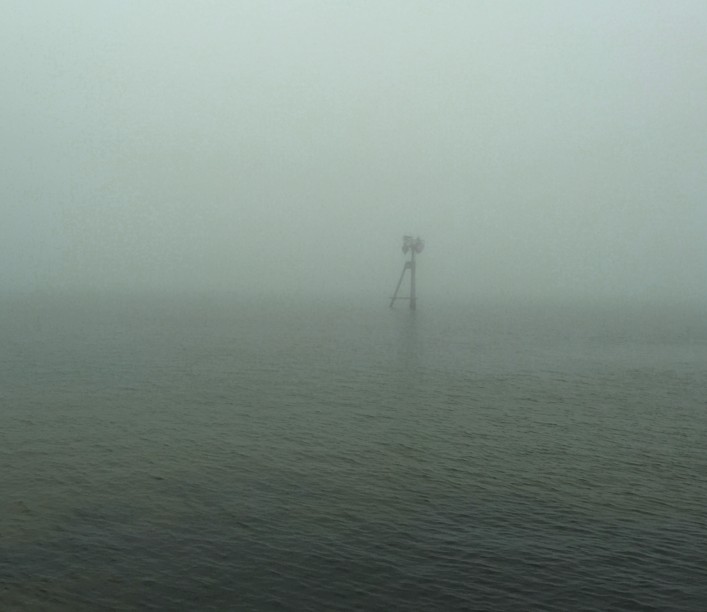
The day on the submarine rock had quietly impressed itself into my nervous system. I could not reproduce that exact scene—the marsh, the fog, the horns—but I did remember how it felt: safe and curious, grounded and vast. Over the years, I found myself drawn again and again to sounds that carried even a hint of that same field.
ToneStream, for me, is one way of encoding—and delivering that Garden state in sound.
I can’t fully explain the mechanism, but it feels to me as if the feelings from that early experience—safety, openness, the sense of being connected to something larger without losing myself—have been impressed into the tones, sounds and sequences I work with now.
The pure sine‑like tones, the slow upswell and decay, the way different elements overlap without locking into a fixed melody or harmony—all of that is my way of recreating “asynchronous fog horns in grey air” in a form you can carry in your pocket.
Sometimes I think of the ToneStream as a kind of carrier wave. The frequencies, the harmonics, the pacing of ToneStream: that is the carrier. The “modulation” riding on top of the carrier wave is the lived feeling from that day on the rock—safe and curious, grounded and vast.
When I listen to ToneStream now, especially in soft‑focus sessions where I give it my full attention, I can feel myself returning to that field. Not to five‑year‑old me exactly, but to the quality of that state, alive right now.
In the final part of this series, I’ll share what this has meant in practice—how spending time in that field has changed me, and why I believe it is not just “my” Garden.